Terrarium is an enclosure or artificial safe house for keeping small animals including insects, reptiles, molluscs, and small mammals etc. It contains soil, plants and water so that basic habitat and feed requirements of kept animals could be supported. Alternatively, natural food material can also be supplied timely. Small animals (for example butterflies or moths or snails) are collected from the local environment with suitable device and are released in the terrarium where they are free to move, feed and rest and perform their lifecycle activities. After observation, the kept animals are released back in the area from where they were caught. Size of the terrarium can be determined variably, as per the requirement.
In this exercise we are describing how we can make a terrarium and keep small animals safely in the terrarium for study purpose.

Image: Image of a Terrarium
A Terrarium * The terrarium is a kind of box or chamber that is covered from top with a mesh to allow air circulation and walls of transparent material sheets. The walls may be made of opaque sheets having windows of transparent material to facilitate view through sides. The floor is covered with soil in which living plants are fixed. These plants may be chosen according to host specificity (i.e. providing host to a particular species like a butterfly or other insect) or any native vegetation including moss, fern, grass, herbs etc. Water is kept in small pots, preferably earthen pots so that butterflies / bees / moths etc can take water from its wet surface.
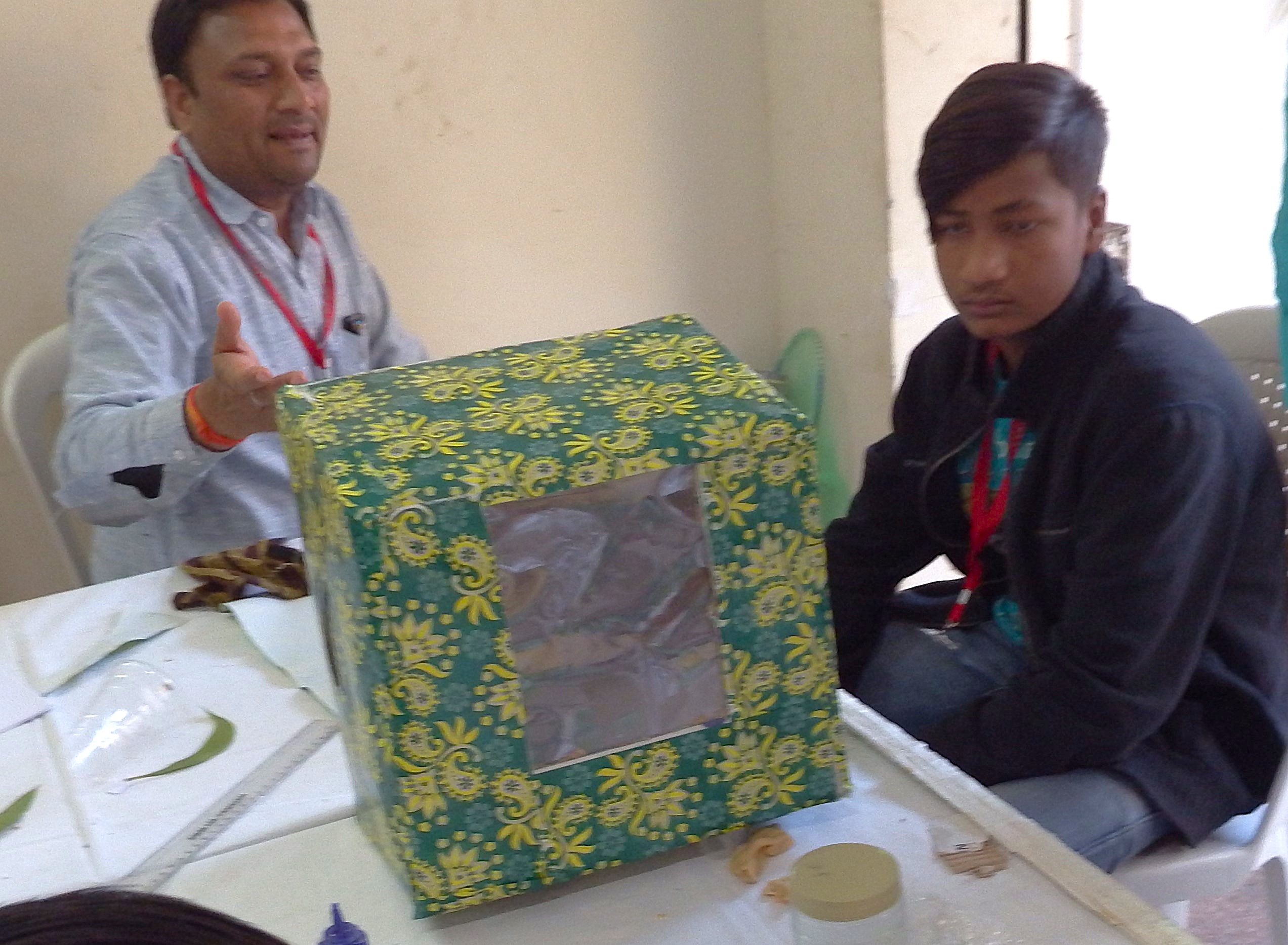
Image: Making of a Terrarium
* Assemble a terrarium with food and water facility
* Release the animals to be kept under observation, in the terrarium and cover its top open part with mesh or perforated lid.
* Observe the animals kept, for the observation purpose they are kept i.e. diurnal activities, food and feeding, movements, morphology, behaviour, life cycle activities, mutual interactions etc.
* Prepare a diurnal time budget of the animal for its activities (i.e. types of activities the animal do for total respective duration in 24 hour time period. For example, resting: 5 hr., Feeding 0:30 hr.; Movement 2:45 hr. etc).
* You can make sketches of the animals and/or take their photographs of various activities.
* After required observation the captivated animals are released back to nature.
- Data related to the body parts of animals and their behavior is recorded in the tables. This enables us to collect details about the animals. This also helps to compare the features of different animals studied in the terrarium.
An example of observation table is shown here; you can make any data format according to the purpose.
|
S. No. |
Name of Animal |
Hand Drawn Sketch of the Animal |
Important Observation about the Animal |
|
|
|
|
|
|
|
|
|
|
* Do the insects or other animals react to or respond to different colour lights? Examine by illuminating with different artificial lights in the terrarium.
* Observe the housing requirements (dwelling place) of different animals and explore which animals you can keep in the terrarium and which you can not.
You can present your observations in the form of quantitative and/or qualitative data.
Hand drawn sketches and photographs will be an additional record to display.
* Terrarium is a very convenient, easy to assemble and easy to operate device to keep small animals for observation.
* Terrarium provides convenient environmental conditions to the captivated animal and the keeper can maintain the conditions as per the need of a particular animal.
* One can easily study the morphology (external body parts), morphological adaptations, activities and behavior of small animals using this method.
Not found any interesting fact.

